
The Military Sends Its Best, the Bureaucracy Sends Its Unwanted: Two Services with Opposite Directions in Balochistan
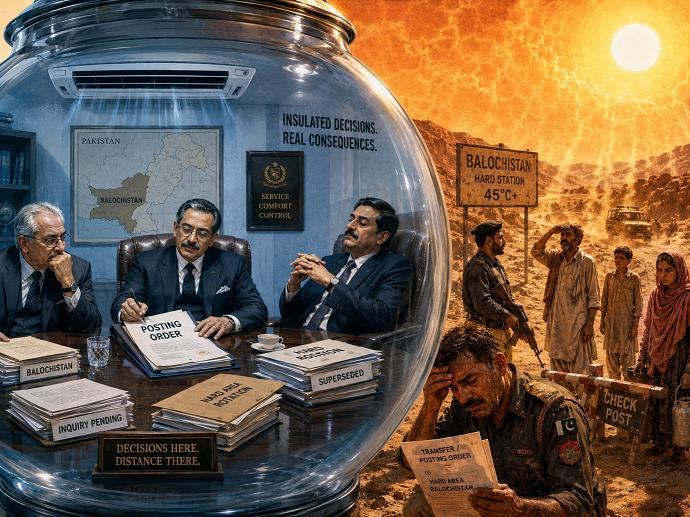
In 1892 the Scottish chemist James Dewar (1842–1923) built a vessel whose entire purpose was to ignore the world. Two walls of glass, a vacuum drawn between them, the inner surfaces silvered so that even radiant heat would be turned back: whatever was poured inside kept its own temperature, and whatever happened outside — frost, furnace, the turning of seasons — registered nothing within. Physics calls such a body an adiabatic system. It exchanges no heat with its surroundings, and its one certain property is that no signal from outside ever reaches its contents. It is a catastrophe of design when it becomes governance policy of a country of 24 crore — 241.5 million — people.[i]
Apathy and insensitivity are Pakistan’s national disease. However, one stratum of society is particularly saturated with it, and the saturation is not accidental but manufactured. And that stratum is the so-called superior bureaucracy. Insulation is the physics of apathy. Where a wall admits no heat, there it admits no news also; and a class that has arranged never to feel what the governed feel cannot be expected to know what the governed know. The comfort of the chilled room is manufactured by pumping its warmth into the street outside, where the public stands, so that the temperature gap between officer and citizen is not a coincidence of privilege but the exact physics of it — and the electricity that pays for the exporting is drawn from the citizen’s account.
The plains and deserts of this country are described as having two seasons: six months hot and six months very hot. The saying is not exaggeration. Jacobabad’s name is a byword for heat across the subcontinent; Mohenjo-Daro in Sindh reached 53.5°C on 26 May 2010;[ii] and the national record of 53.7°C, set in 2017, stands among the four highest temperatures the World Meteorological Organization has ever verified anywhere on Earth.[iii] Into this climate the state has erected concrete boxes — flat roofs, thin walls, glass fronts — built on drawings that owe more to the latitudes of northern Europe than to the plain of the Indus, and it has made them habitable by one instrument alone: the air-conditioner. Probably, the colonial predecessors of these bureaucrats knew better. They built the bungalow of thick walls and high ceilings, the deep veranda, and the khus screen of wetted vetiver grass. Unfortunately, the heir has proved more foreign to the soil than the foreigner was. The adiabatic flask travels as well: the air-conditioned luxury vehicle is the same room on wheels, fueled at public expense, with tinted glass in place of silvered walls, so that the officer may cross the heat of his own district without once being touched by it.
Now consider the dress. In a country that spends half its year above 40°C, the governing class conducts its business in the two-piece and three-piece suit, the necktie knotted at the throat, the woolen jacket buttoned — the costume of a people who evolved their clothing against snow. Reasons may be complex. However, a generally cited reason is the class that Thomas Babington Macaulay (1800–1859) proposed in 1835 to form: “Indian in blood and color, but English in taste.”[iv] Our bureaucrats interpreted ‘taste’ as limited to dress alone; the taste for empathy, good governance and sustainability was not touched at all. What an irony that the resemblance stops at the cloth. A necktie in Multan or Jacobabad does not make one like the minds and institutions of Stockholm.
Actually, the journey into the flask begins much earlier. The Central Superior Services examination — CSS, the annual competition through which Pakistan recruits its federal civil service — is a colonial instrument in its bones, and the single greatest determinant of who enters is the English essay. The Federal Public Service Commission (FPSC) reported in 2016 that 92 percent of candidates had failed in English,[v] and the government told the National Assembly in May 2026 that the bulk of failures still fall in the essay and the precis papers.[vi] A candidate is thus selected chiefly on the ability to write formal English prose within a fixed three hours; what is not tested is the candidate’s field, aptitude and temperament for the job. The examination does not select the best minds; it selects the best prose, and then hands the country to those prose writers. No wonder that the whole bureaucracy does not travel beyond the prose-ridden file and the presentations. The ‘mini philosopher kings’ bred by this gate arrive with a general background and defend it as a monopoly: having no specialization of their own, they neither develop one nor permit a specialist to enter the circle of power and grow within it. Hence the MA in history sits over public finance, and the graduate in political science drafts the policy of science and technology. An officer selected for prose has one field left in which to excel, and it is the field of the necktie — and if one goes one step further, into sycophancy in scented English, there is no ceiling to the ‘rise’.
Such apathy, arrogance and incompetence would be a tolerable vice if it stayed inside the general spheres of public policy and governance, where its price is paid slowly and in the coin of missed decades. But it does not stay there. Many times, it touches the matters of national security and survival, and it touches them with the same adiabatic mind. The latest example is Balochistan. The province covers 347,190 square kilometers (134,050 square miles), 43.6 percent of the country’s land, and holds 1.49 crore — 14.9 million — people, 6.2 percent of the population.[vii] In 2025 it suffered at least 254 terrorist attacks, 26 percent more than the year before, with more than 400 dead;[viii] a passenger train was hijacked in the Bolan pass on 11 March 2025; and on 30 January 2026 coordinated attacks struck at least nine districts in a single night.[ix] It cannot be ruled out that the province is, at this moment, the hardest station the state has to fill. A station of that kind needs officers who are career-committed, competent, and fully enabled — in authority, in equipment, in law and in mind — to shoulder and execute the sensitive duty of fighting an armed challenge to the state’s existence.
What kind of officers are being sent to Balochistan by the Civil Bureaucratic Establishment? The federal Bureaucratic Establishment, which holds the postings, transfers and promotions of the All-Pakistan services in its hand, sends to Balochistan, in a manner typical of the apathetic attitude, those officers — especially the police officers — who are least able to fight. It sends those who are out of favor with their superiors. It sends officers with inquiries pending against them. It sends officers deferred or superseded in promotion. It sends officers on the verge of retirement, and it sends officers who have scarcely finished their training. In short, it sends the file it wants closed, not the officer it wants to win. Reporting from May 2026 records ten police officers transferred from Punjab to hard stations in Khyber Pakhtunkhwa and Balochistan under a policy intended for young officers, among them recently encadered officers with three to five years of service remaining and officers called into a promotion course by the very department that then ordered them away from it.[x] Under the same federal direction, probationers of the most junior batches have been dispatched to the province on rotations of 365 days.[xi] As per the Rotation Policy of 2020, two years in a notified hard area is a condition of a male officer’s promotion[xii] — which means the hardest station in the country is administered, on paper, as a formality to be completed, and in practice as a place of exile.
The consequence is exactly what a governance physician would predict from the prescription. What is an officer to defend, who is himself under investigation? What is he to command, who has just learned that his juniors have been promoted over him? What is he to plan for a three-year campaign, who has eleven months to retirement and a pension file that can still be stopped? And what is a probationer to learn about counter-insurgency in 365 days, of which the first ninety are spent finding a house that will not be attacked? The posting order does not merely fail to enable such officers; it ensures that they remain in a continuous tortured state of mind, unable to focus on anything but the injury that sent them. The negentropic state — the state read as an order-producing engine, judged by the certainty it manufactures for its people — has here manufactured entropy in the one mind it most needed ordered. A wound cannot stand guard.
A stranger to this country, reading only the Balochistan posting orders, would conclude that the federal Bureaucratic Establishment has signed a memorandum of understanding with the enemies of the state. It has not. However, no memorandum could have served those enemies better. The contrast within the state itself is the sharpest indictment. The armed forces, facing the same province, send their best: operational command in a hard area is the rung on which a military career climbs, the officer’s record is read before the posting is written, and a commander is chosen because he is wanted there, not because he is unwanted elsewhere. The civil service faces the same furnace and walks in the opposite direction, and the direction is most pronounced in the police officers whom the Bureaucratic Establishment selects for Balochistan — the officers who will stand beside the constable in the street when the explosion comes.
Who, then, is sacrificed? Not the officer with what the service calls a ‘godfather’ — a patron at the center who can have an order rewritten in a day; that officer sees Balochistan only from an aircraft window on the way to a conference. The officer who goes is the one with no patron: the inter-class immigrant, in plain words — the entrant from the lower middle class catapulted into an elite service by an examination, whose only capital is his record, and whose record is precisely what the inquiry has stained. He is sent because he cannot refuse, forgotten because no one asks for him, and blamed when the station fails, because the failure was scheduled at the moment of posting. And on the other side of the same order stands the public of Balochistan, which receives as its guardian a demoralized stranger counting his days. The apathy that begins in a chilled room ends at a checkpoint on a highway, where the price is paid in blood by people who never entered the chilled room.
Diagnosis obliges prescription. It is needed that officers who are fighting a war on the country’s behalf be kept outside the reach of this apathy altogether, and be managed and governed by a special-purpose governance-enabling cell inside the institutions that deal with national security and survival. Leaving the matters of national security to a posting practice with a proven record of exclusion and failure would be a neglect of extreme consequence. In view of the foregone, the following measures are offered as proposals for Balochistan, and for any other station the state may notify as security-critical. They are addressed to the state as a whole, because the department that built the flask cannot be expected to break it.
- A Balochistan postings cell. A special-purpose governance-enabling cell is created for Balochistan under the forum where the civil and military leadership already sit together on internal security, and it alone selects, posts, protects and supports the civil officers — police officers first — sent to the province. Routine rotation and the Bureaucratic Establishment’s ordinary posting powers stand suspended for Balochistan. The cell reads the record of every candidate before writing the order, as a military posting board does.
- Positive selection, and a bar on negative selection. No officer under inquiry, deferred or superseded in promotion, within three years of retirement, or in the first two years after training is posted to Balochistan. Selection rests on merit, prior operational performance and stated preference, and such a posting becomes a distinction on the record rather than a sentence.
- Enablement before dispatch. Every officer posted to the province carries full statutory authority to act without reference; legal-defense and indemnity cover funded by the state; equipment, intelligence access and communications on the standard of the armed forces; and a written statement of mission and resources signed by the cell. An officer who has not been enabled is not posted.
- Tenure and the guaranteed return. A fixed tenure of three years, interrupted only by the cell and only for cause recorded in writing; a guaranteed posting of choice on return; a hard-area premium equal in value to the field allowances of the armed forces; and each year served in Balochistan counted as one and a half years for seniority and pension.
- The family covenant. Secure family accommodation, in the province or in the province of origin, at state cost; guaranteed school and university admission for children; medical cover on the standard of the armed forces; and a welfare officer inside the cell whose telephone the family can reach at any hour.
- Accountability of the sender. An annual return is laid before Parliament showing, for every officer posted to Balochistan, the career stage, and promotion status at the time of posting. Exclusion becomes visible, and a practice that cannot survive being seen will end.
- Repair of the gate, nationally. The disease being general to Pakistan, its remedy is general also: the examination itself is reformed over a longer horizon — allocation to service groups linked to discipline, lateral entry of specialists at senior levels, and the English essay judged as one competence among several rather than the gate that decides all.
- A direct line above the flask. The Inspector General of Police and the Chief Secretary of Balochistan — the province’s senior police officer and its senior civil servant — are given hotline access to the federal government in Islamabad and to the army’s General Headquarters in Rawalpindi, so that the two officers who carry the province reach the political and military leadership directly, without passing through the flask this article describes.
Summing up, a state that sends its wounded to the front has already signed the surrender it will later call fate. The measures above are not favors to a service; they are the minimum a country owes to those it sends into fire, and the minimum it owes to a province that has waited too long to be governed by anyone who wished to be there.
*******
Footnotes
[i] Pakistan Bureau of Statistics, 7th Population and Housing Census 2023, final results: total population 241,499,431.
[ii] Pakistan Meteorological Department station reading for Mohenjo-Daro, Sindh, 26 May 2010 (53.5°C), as recorded in the national extreme-weather record; it stood as the national maximum until May 2017.
[iii] World Meteorological Organization, press release of 18 June 2019 on the evaluation of the Mitribah (Kuwait) and Turbat (Pakistan) observations: Turbat verified at 53.7°C ± 0.4°C on 28 May 2017, Mitribah at 53.9°C ± 0.1°C on 21 July 2016; the two are the third and fourth highest WMO-recognized temperatures on record.
[iv] Thomas Babington Macaulay, Minute on Indian Education, 2 February 1835.
[v] Dawn, 6 December 2016, reporting the Federal Public Service Commission’s briefing to the National Assembly standing committee on the CSS 2016 results: 92 percent of candidates failed in English and 82 percent in the essay paper; the overall written pass rate was 2.09 percent.
[vi] Dawn, 17 May 2026, reporting the government’s written reply in the National Assembly on CSS failure rates, which identified the English essay and English precis and composition papers as the principal points of failure.
[vii] Government of Balochistan, official portal (balochistan.gov.pk): area 347,190 sq km, 43.6 percent of the national territory; Pakistan Bureau of Statistics, Census 2023: provincial population 14,894,402.
[viii] Pak Institute for Peace Studies (PIPS), figures for 2025 as reported in press coverage of January–February 2026: at least 254 terrorist attacks in Balochistan, an increase of 26 percent over 2024, with more than 400 deaths.
[ix] The hijacking of the Jaffar Express in the Bolan district on 11 March 2025 and the coordinated attacks of 30 January 2026 across at least nine districts were reported by all major Pakistani and international outlets on the days following each event.
[x] Dawn, 4 May 2026, on the transfer of ten police officers from Punjab to notified hard areas in Khyber Pakhtunkhwa and Balochistan for a mandatory one-year period, including officers encadered from the provincial service in 2020–21 with three to five years of service remaining and officers simultaneously ordered to a promotion course.
[xi] Balochistan Pulse, 27 September 2025, on the relief of thirteen officers of the 47th Common Training Programme after 365 days of active service in the province and the induction of seven officers of the 48th Common, under the federal government’s phased posting of junior officers to the province.
[xii] Government of Pakistan, Rotation Policy for PAS/PSP Officers (updated 5 August 2020), clause 12: every male officer must serve a minimum of two years in notified hard areas during BS-17 to BS-19; reported in The News, 6 August 2020.

- Two Services with Opposite Directions in Balochistan - 30/08/2026